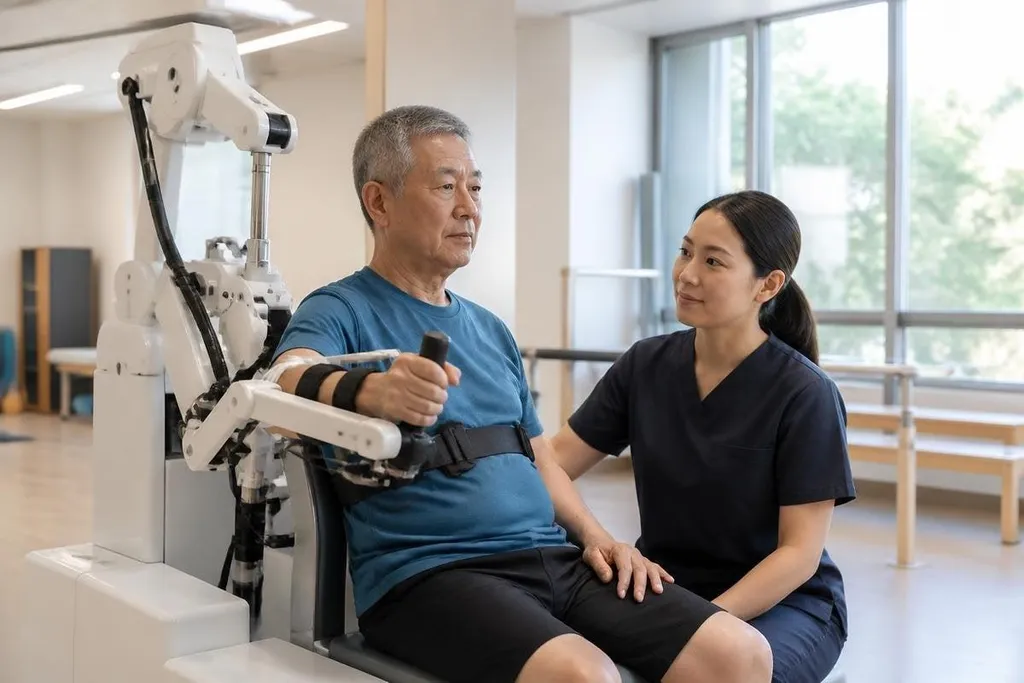
A rehabilitation robot can guide a weak arm or leg through repeated movements while a therapist watches the patient’s form. The useful question is where that support fits, because a robot can train a motion but can’t decide what a person needs after a stroke.
- Robotic systems guide repeated arm or leg movements.
- Sensors record force, speed, range, and errors during exercises.
- A therapist still sets the task and checks how the patient responds.
Repetition with less strain
Stroke recovery often involves practicing a movement many times. A robotic device can hold part of the limb’s weight, guide the joint along a set path, or add resistance when the person can move more on their own.
That support can make a task possible when the arm or leg is too weak for a full movement. The device may also reduce the physical load on the therapist, who can spend more time watching posture, attention, pain, and fatigue.
The machine should not force a stiff or painful joint through its range. A clinician needs to set the motion, speed, and force for that person, then change those settings as their movement changes.
What the robot measures
A therapy session can produce more than a therapist’s notes. Sensors may record how far the joint moved, how much force the person used, how smoothly they moved, and how often the robot had to help.
Those measurements can show small changes that are hard to see during a short visit. They can also show when a person is relying on the device instead of doing more of the work themselves. The numbers still need context, since a tired patient may move differently from one session to the next.
For stroke rehab, reports on rehabilitation robots can tie a machine’s movement to the work a patient completed in therapy. The useful record includes the task, support level, and measured change, rather than a video of an arm moving on its own.
The main types of therapy robots
Arm systems may attach to the forearm or hand and guide reaching, lifting, or grasping tasks. Some systems use a handle, while others connect to the arm at several points. The setup affects which joints the person can train and how much help the robot can give.
Leg systems can support walking practice on a treadmill or help move the legs through stepping patterns. Exoskeletons place motors and sensors around the body, so fit matters. A poor fit can make a task uncomfortable and can change the way a person walks.
Some devices use a game or screen to show targets. That can give the person a clear task, but the screen doesn’t prove that the movement will carry over to standing, dressing, or walking at home. Those daily tasks need separate checks.
Where robots fall short
A robot can repeat a planned movement with steady timing. Human recovery is less tidy. Strength, balance, vision, speech, attention, and mood can all affect a session, and a machine may not spot every change.
Cost, space, setup time, and staff training also shape access. A device that needs a large room or a trained operator may fit a hospital but make little sense in a small clinic.
Home systems add another concern: someone must fit the device, check the skin, manage the software, and respond when movement becomes painful.
The evidence for a specific device also needs careful reading. A maker may report how many sessions took place, but that number alone doesn’t show how much the robot changed a person’s daily function. Look for the task tested, the comparison used, the length of follow-up, and who measured the result.
A practical check before treatment
Use this list with a rehabilitation professional before choosing a robotic system:
- Name the task: Is the goal reaching a shelf, standing, taking steps, or another daily action?
- Check the fit: Can the device match the patient’s height, limb length, joint motion, and level of strength?
- Ask about help: How much of the movement does the robot make, and can that support decrease over time?
- Review the data: Which measures are recorded, and how will the therapist use them at the next visit?
- Set a stop rule: What signs of pain, skin pressure, dizziness, or fatigue end the session?
- Plan the handoff: How will practice with the robot connect to ordinary tasks outside the clinic?
I'd choose a system for a defined therapy task and a clear measurement plan, not for its motor count or polished demo.
The next useful result is a change the patient can use: a longer reach, a safer transfer, or more steps with less help. Ask the care team which number will show that change, and when they’ll measure it.